Swiss Systems
Engineering Day
by SSSE
Swiss Systems
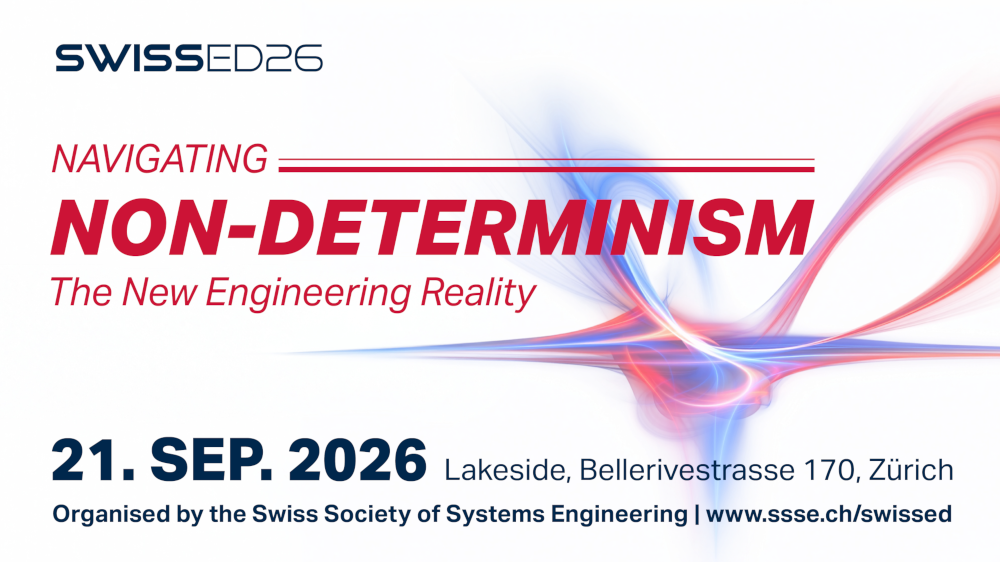
Engineering Day (SwissED)
The Swiss Society of Systems Engineering (SSSE) annually hosts the Swiss Systems Engineering Day (SwissED).
SwissED26 will be the 13th annual symposium of the Swiss Society of Systems Engineering (SSSE). SSSE acts as the Swiss Chapter
of the International Council on Systems Engineering (INCOSE).
This one-day event brings together first- class presenters and practitioners, to share knowledge and experience on how to plan, develop and manage systems in an efficient and successful way. This year, our conference will be run as an inperson event in Zürich, with NO virtual attendance. The keynotes will be recorded and published on our youtube channel.
The central theme of the 2026 conference is "Navigating non-determinism: The new engineering reality".

Do you want to join the conference as an attendee?
Join us on 21th of September 2026 in Zürich
Program 2026
Doors open, Registration & Refreshments
Welcome
Navigating Non-Determinism: The New Engineering Reality
Refreshment
YARC – Yet Another Requirements Classification?
Lunch
Refreshments
Best Presentation Award & Closing
Apéro & Networking
SWISSED26 Keynote Speakers - Details

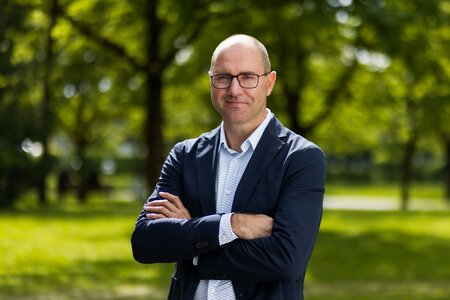

This year, the SWISSED brings together practitioners and academics, by presenting inspiring keynote lectures.
It is our great pleasure to introduce the keynote speakers for this year’s SWISSED:
Nico Michels, a mechanical engineer and systems engineer from Hanover, has more than 20 years of leadership experience in the strategic development and successful implementation of digital transformations in international manufacturing companies. As a long-standing top manager, he has held operational responsibility for complex, globally distributed engineering, production, and IT systems. He is actively involved in innovative research projects with industry, academia, and politics, and serves as a speaker and lecturer in product development and digitalization. Since December 2022, he has been Managing Executive for Digital Enterprise at Siemens Digital Industries Software, where he advises and supports board members and top management in digital transformation initiatives. His strategic and operational focus lies on a holistic, systemic approach and strong collaboration within an international ecosystem.
Keynote: Systems Engineering in the Age of Non‑Determinism: From Digital Twins to Agentic Engineering
Modern engineering faces a fundamental shift: increasing system complexity, interconnected ecosystems, and the growing use of AI introduce a new reality of non‑determinism. Traditional engineering approaches, built on predictability and control, reach their limits.
This keynote explores how Digital Enterprise concepts like Systems Engineering, Digital Twins and industrial-grade AI enable organizations to navigate this new landscape. At the core lies a connected data foundation – combining Digital Twins, knowledge graphs, and AI – that transforms fragmented data into contextualized, actionable intelligence.
Building on this foundation, engineering is able to evolve towards adaptive, fast, and sustainable systems where engineering processes integrate product, production, and service across the full lifecycle.
Finally, the keynote outlines how agentic AI and human‑AI collaboration will fundamentally change the role of systems engineers – from designing systems to orchestrating intelligent, hybrid engineering ecosystems.
Elena Cortona joined Belimo Automation AG as CTO in June 2021. She is a member of the Group Executive Board and heads the Group Divison Innovation (R&D).
From 2001 to 2021, she held various positions at the Schindler Group.
Most recently, she was responsible for digital transformation across the entire value chain and defined strategic goals, methodologies, and the IT/IoT tool landscape for the design, production, installation, and maintenance of elevators. From 2007 to 2017, she served as Technical Director at Schindler 7000. In this role, she led the development of elevators with a height of up to 500 m for the global market and propelled Schindler to the top of this product segment. From 2005 to 2007, she headed the research and development team at Atlas Schindler in São Paulo, Brazil, and was involved in the strategic planning of the Schindler Group’s R&D globalization.
She holds a Ph.D. from ETH Zurich and a degree in mechanical engineering from the Politecnico di Torino in Italy.
Keynote: Navigating Non-Determinism: The New Engineering Reality
Engineering is entering an era where predictability is no longer the norm but the exception. Changing markets and increasingly individualized customer requirements demand systems that are adaptive rather than predefined. At the same time, a new workforce of digital natives reshapes how engineering knowledge is created and applied. Advances in AI, simulation, and automation are no longer optional—they become essential tools to manage complexity and non-linearity. The future of engineering lies in embracing non-determinism as a design principle, leveraging data-driven and self-learning systems to deliver scalable, resilient solutions.
Andreas Spiess is a Swiss electronics engineer, business leader, and technology communicator based in Basel. He holds a Master’s degree in Electronics and a Master in Business Administration from ETH Zurich. Over his career, he held senior roles at Gretag, Digital Equipment Corporation, SAP Switzerland, and Arumba GmbH, including almost 15 years at SAP in leadership positions such as Director e-Business, Head of Business Consulting, and Head of Active Global Support.
Keynote: From Functional Requirements to Bounded Behavior — Systems Engineering in the Age of AI
In this presentation, Andreas Spiess — veteran electronics maker, embedded systems practitioner, and one of the most trusted voices in the European maker and engineering community — brings the abstract conference theme down to earth (Zurich LakeSide) with his hard-won practical insight. Drawing on his direct experience integrating AI agents into real engineering workflows, the talk illustrates what agentic engineering actually looks like when it meets the complexity and messiness of the physical and AI-driven world.
The talk opens by naming the tension honestly: systems engineering's beloved V-Model was designed for determinism. But today's systems — driven by AI/ML, complex software stacks, autonomous behaviour, and volatile environments — no longer behave in ways any specification table can fully anticipate. This is the present condition, and the systems engineering community, including INCOSE's AI Systems Working Group, is already responding. To navigate it, the keynote distinguishes two fundamentally different cases that demand different engineering responses.
Case 1 — AI writes the code
In the first and increasingly familiar case, AI becomes part of the engineering workflow: writing specifications, generating implementation, tests, documentation, and debugging support under human supervision. Here, the V-Model remains valid. Specification, verification, validation, and the responsibility model do not disappear — only parts of the implementation work are delegated. The engineer's role moves up the abstraction ladder, from writing code to specifying intent and judging outcomes. He is promoted to a group leader for a bunch of AI agents.
What becomes more important is testing. Engineers now work with what the speaker calls open black boxes — code that is source-available but functionally opaque, because no human wrote it line by line. AI also gives engineers a powerful new tool: Enormous numbers of test cases can be generated and executed automatically. Spiess goes a step further and uses AI to scan the specification as well as the generated code for edge cases the specification did not foresee, then folds those into the test suite. He also talks about testing strategies of connected systems. New strategies are needed here because of the explosion of test cases.
Case 2 — AI becomes part of the delivered system
In the second case, AI replaces code inside the runtime. A model, prompt, agent, or classifier becomes part of the system's behaviour in production. The V-Model still provides useful lifecycle structure, but verification must change fundamentally. Engineers are no longer verifying deterministic logic; they must validate behaviour across probabilistic, changing, and sometimes non-reproducible operating spaces. The shift is from functional requirements — "the system shall do X" — to bounded behaviour: defining the operating envelope, the acceptable failure modes, and the guardrails within which a non-deterministic component is allowed to act.
The constant: testing discipline and human responsibility
Across both cases, one credo holds tighter than ever: if it is not tested, a system has to be considered not working. This principle, always sound in systems engineering, becomes existential when working with AI. Probabilistic components punish optimism; only evidence counts.
And in both cases, responsibility remains human. AI systems cannot be sued. Engineers, organizations, and decision-makers remain accountable for what is specified, released, operated, and accepted. The role has not disappeared — it has evolved. We are no longer reviewing code. We are specifying and bounding behaviour, and we are responsible for the result.
The keynote closes with a practical framework for systems engineers stepping into this new reality: a structured agentic engineering loop that keeps the human firmly in control, and a clear-eyed view of where AI delivers genuine leverage — and where human judgment remains in charge.
Our Partners at SwissED 2026
Platinum Partner

Gold Partner
Silver Partner